

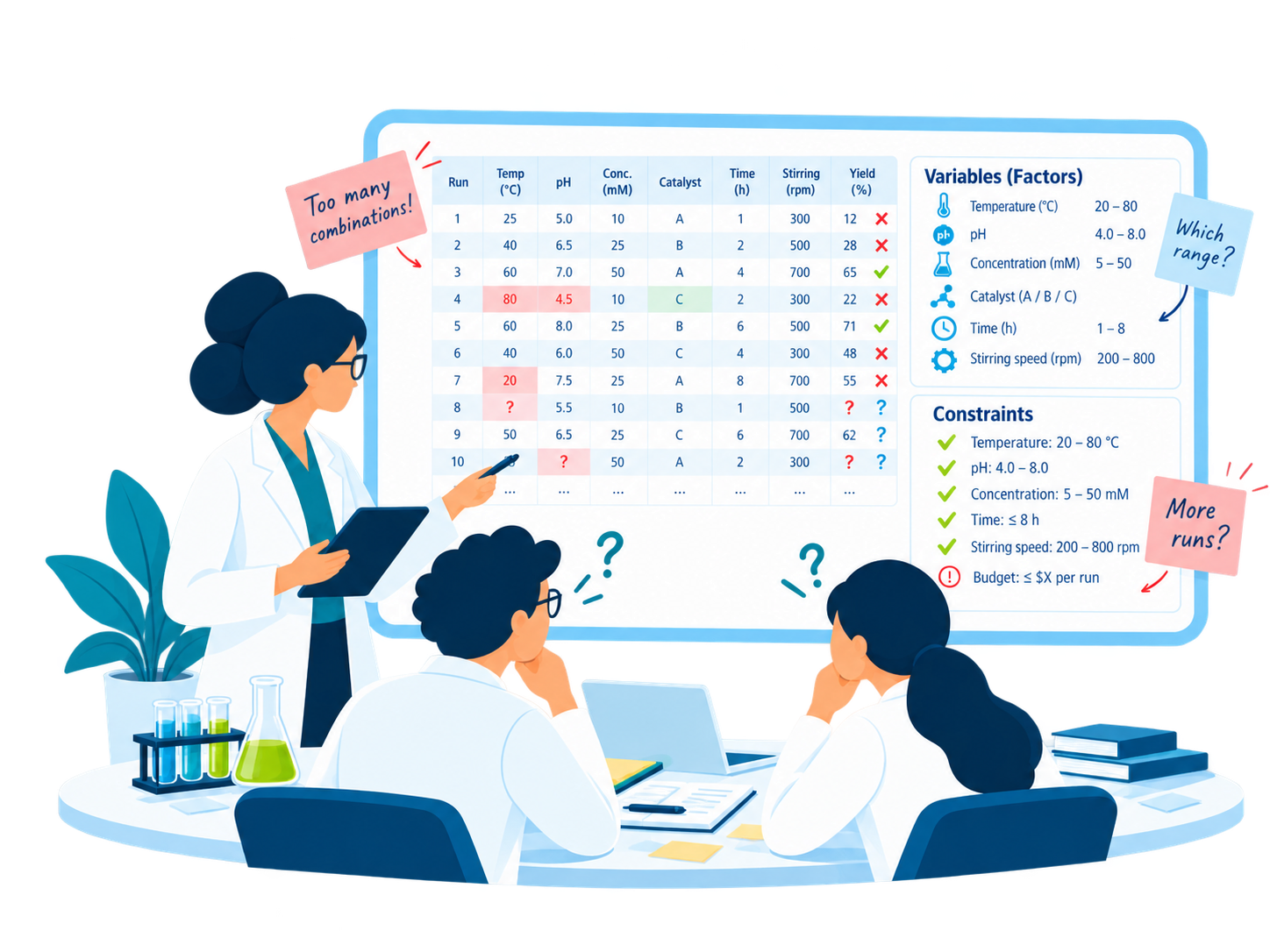
More experiments

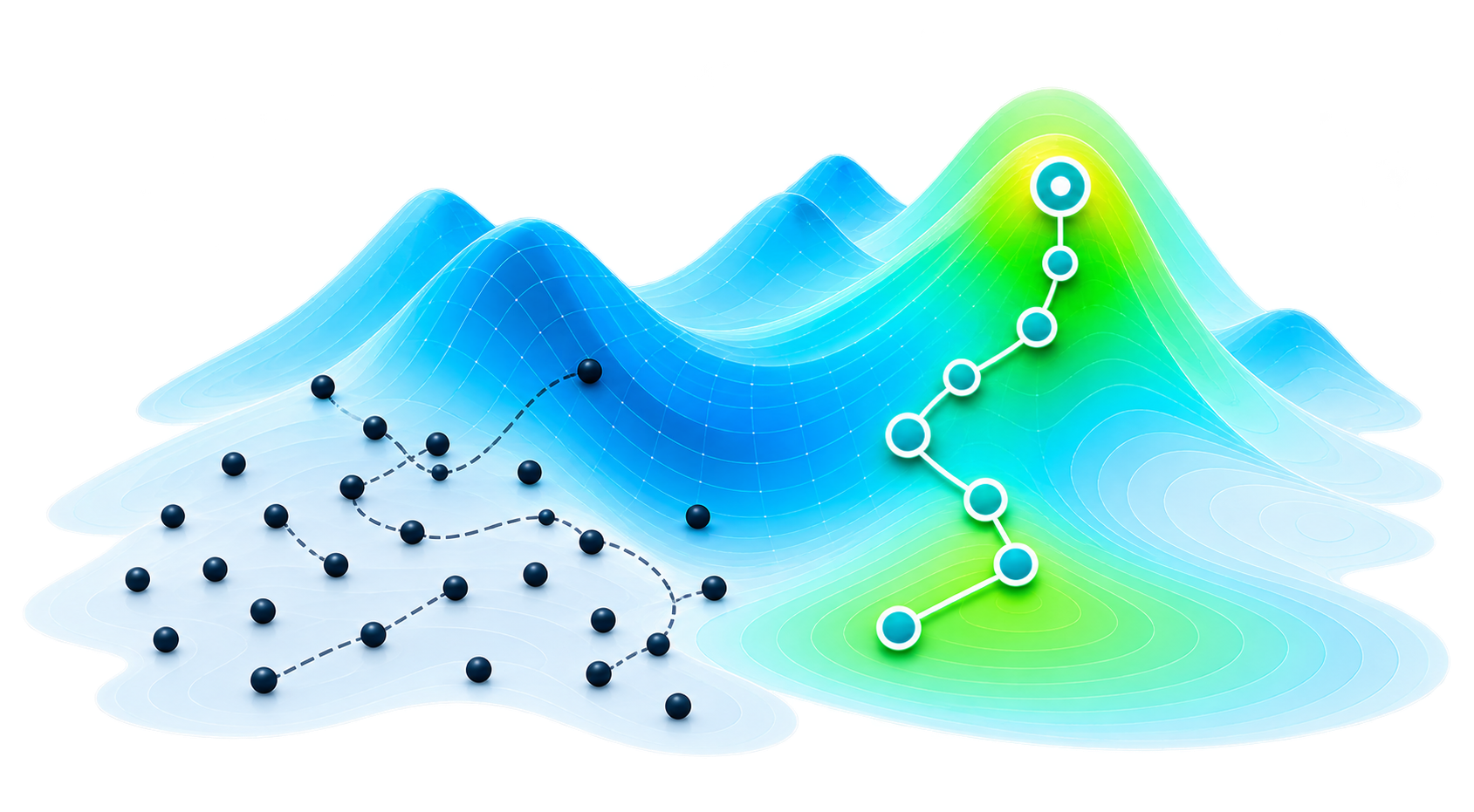
More trials are needed to narrow down which options are worth pursuing.
Turn your experimental data into better decisions and prioritise each run where it can add the most value.
In R&D, every factor multiplies the possible combinations. When several objectives and constraints are involved, deciding what to test next can require many iterations before a clear direction emerges.
Each new factor adds new combinations to explore.
Improving one response may compromise others.
They define which combinations are feasible and narrow the search space.
More trials are needed to narrow down which options are worth pursuing.
The cycle between testing, analysis and the next decision takes longer.
Additional iterations increase resource consumption and equipment usage.
Validation takes longer, delaying the launch of new products or processes.
DxTER turns every result into useful information for deciding what to test next.
Focus testing on informative or promising combinations.
Build on the knowledge accumulated in each cycle.
Reduce effort spent on combinations of little interest.
Work with multiple factors, responses, objectives and constraints.
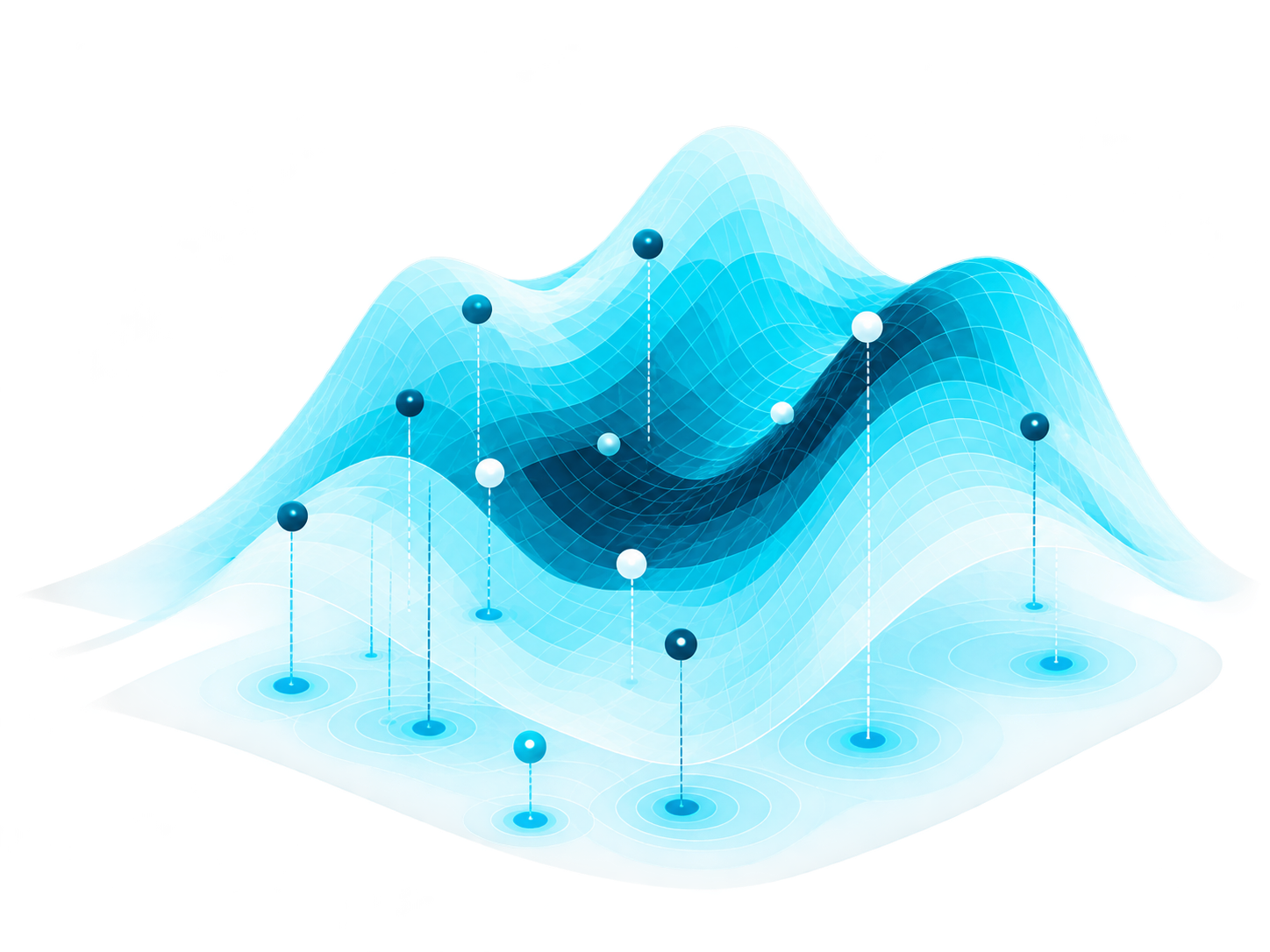
From your experimental results, DxTER builds a model of the process and uses it to decide where it is worth experimenting next.
Use the experimental results you already have as the starting point.
Estimate how factors and responses relate and quantify uncertainty.
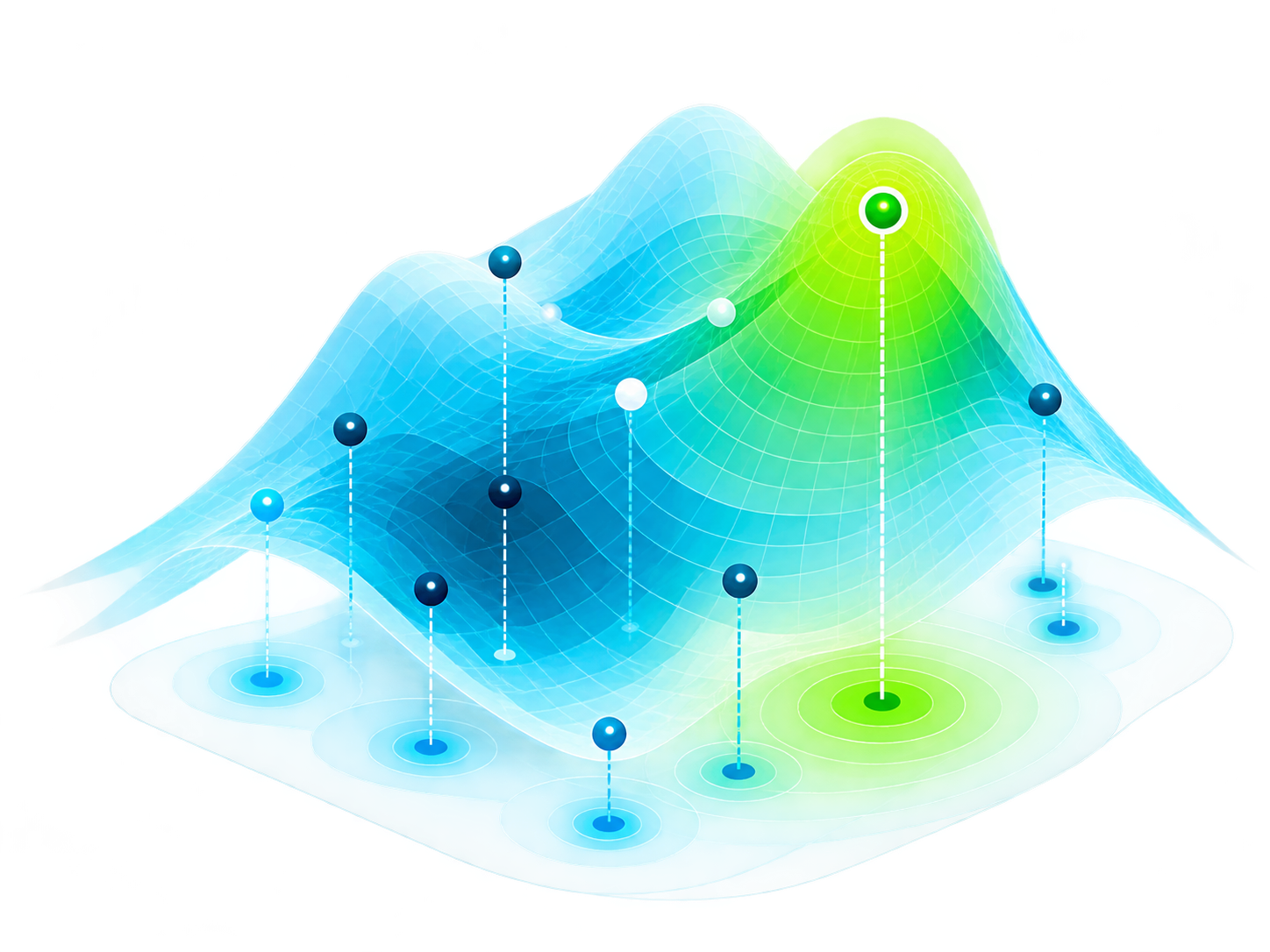
Identify the most relevant conditions for moving towards your objectives.
The process repeats: every new result updates the model and helps refine the next recommendation. Select a stage to explore the loop.
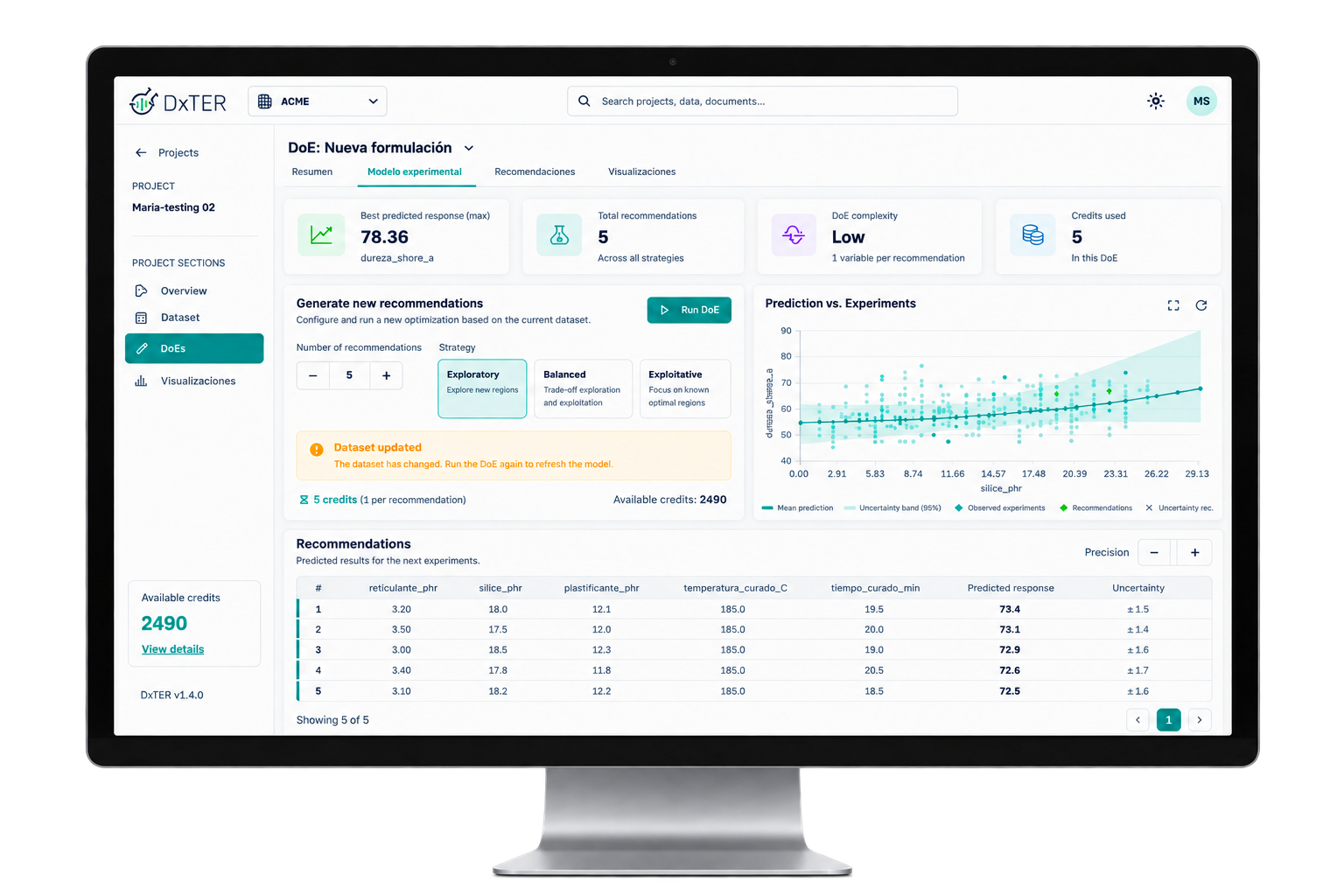
Analyse, configure, predict and generate recommendations from a single working environment.
Explore results and relationships between factors and responses.
Define factors, responses, objectives and constraints and choose the search strategy.
Evaluate expected responses and uncertainty for new combinations.
Receive prioritised experimental conditions for the next run.
The same optimisation logic applied to very different experimental challenges.
Optimise formulations and compositions against multiple target properties.
Identify promising experimental conditions in processes with multiple variables and constraints.
Optimise configurations, materials and process parameters with fewer design iterations.
Bring virtual results into the optimisation loop to evaluate more alternatives before moving to physical testing.
Discuss integration →Centralise your team's experimental work in a web environment with controlled access and organisation-level data isolation.
Work from the browser, with no installation or local dependencies.
Share data, experiments and results with your team.
Organise projects and decide who can access the information in each one.
Information remains isolated by organisation and the production infrastructure is hosted in Spain.
Monthly per-user subscription, AI credits included, and extra packs only when you need them.
Projects and datasetsManage experiments and data.
Collaborative workspaceShare projects and results.
Analysis and visualisationExplore your data, relationships and results.
Design of Experiments (DoE)Configure factors, responses, objectives and constraints.
80 credits/user/monthFor generating AI recommendations.
Browser accessNo local installation.
Prices per user per month.
| Users | List price | Offer | Volume disc. |
|---|---|---|---|
| 1–5 | 50,00 € | 25,00 € | — |
| 6–10 | 45,00 € | 22,50 € | −10 % |
| >10 | 40,00 € | 20,00 € | −20 % |
The launch offer applies to the list price for each tier.
Increase recommendation capacity whenever you need it.
| Pack | Price | Price/credit |
|---|---|---|
| 100 credits | 50,00 € | 0,50 € |
| 200 credits | 90,00 € | 0,45 € |
| 500 credits | 200,00 € | 0,40 € |
| 1.000 credits | 350,00 € | 0,35 € |
Packs are not included in the launch offer and are valid for 12 months from purchase.
Offer until 31/12/202650% off user subscriptions. Credit packs excluded.
Prices exclude taxesApplicable taxes depend on location and tax status.
No commitmentAdjust users according to your team's needs.
The cost per recommendation depends on scenario complexity and is shown before execution. All other platform functionality is included in the subscription.
The 80 monthly credits from each active user are shared across the organisation and can be used wherever they are needed.
We support you with questions and incidents related to using DxTER.
Data, functionality, billing, security and access: the essentials for assessing whether DxTER fits your organisation.
You can build the dataset directly in DxTER by entering experiments and creating variables manually, or, for convenience, upload your data from Excel or CSV.
You can also define units, ranges, physical limits and allowed values so the dataset accurately represents your experimental space.
There is no universal minimum number of experiments. In general, the more high-quality data you have, the better, but quantity is not the only consideration.
The platform helps you understand what type of information the model needs in order to keep progressing.
You can work with one or several objectives and define whether you want to maximise, minimise or approach a target value.
This information tells DxTER where it is allowed to search and prevents it from recommending experimentally invalid conditions.
Yes. DxTER can address multi-objective problems and help you understand trade-offs between competing responses by identifying solutions that offer different balances within the defined constraints.
DxTER uses available knowledge and model uncertainty to help determine which type of search is most useful at each stage.
The user remains in control of the strategy applied.
DxTER checks dataset structure, variable types and missing values before using the data for modelling and recommendations.
Yes. DxTER can integrate with simulation environments to bring virtual results into the optimisation loop and explore more alternatives before moving to physical testing. Integrations with simulators, data sources or proprietary tools are scoped as customised services according to the customer environment.
DxTER is a fully web-based application: computations are performed in the cloud, with no local installation or specific hardware requirements.
If you want to see DxTER in action, validate its fit with your data or explore an integration, tell us about your use case.